Optimal sleep positions for managing obstructive sleep apnoea
Side sleeping: The recommended position
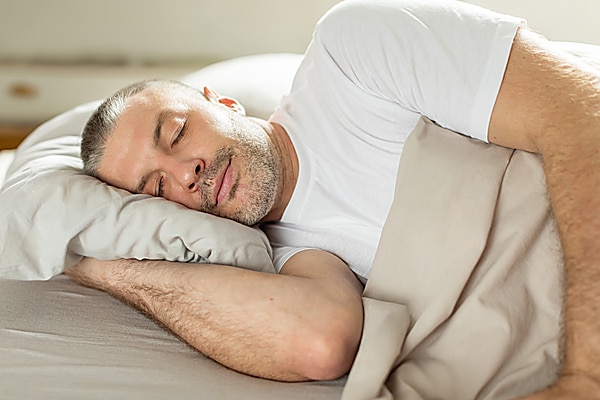
Side sleeping is sometimes recommended to help reduce obstructive sleep apnoea symptoms, though individual results can vary. Sleeping on your side may help reduce the chance of your tongue and soft tissues falling backward into your throat, which can help keep your airway more open.
Sleeping on either your left or right side can be effective, though some people find one side more comfortable than the other. Studies consistently show that side sleeping can significantly reduce the apnoea-hypopnoea index (AHI)3, which measures how many times your breathing stops or becomes shallow per hour.
One study found that positional sleep apnoea affects nearly 50% of people with mild sleep apnoea, nearly 20% of people with moderate sleep apnoea and nearly 7% of people with severe sleep apnoea. 4
Successful side sleeping hinges on maintaining the position throughout the night, which can be challenging if you’re used to sleeping in other positions. Even if side sleeping seems to lessen your obstructive sleep apnoea symptoms, positional therapy isn’t a substitute for medically recommended treatments like CPAP.
Elevated sleeping positions
Sleeping with your upper body elevated at a 30- to 45-degree angle may help reduce airway blockages for people living with obstructive sleep apnoea. Like side sleeping, an inclined position uses gravity to help limit throat tissue collapse that can contribute to airway blockages.16, 17
You can sleep in an elevated position by using an adjustable bed, which offers flexibility to find a comfortable angle for sleep. Some studies suggest that slightly elevating the head of the bed may help reduce OSA severity without affecting sleep cycles.5
Alternatively, wedge pillows or even multiple regular pillows can create an inclined position if an adjustable bed isn’t feasible. Wedge pillows are designed to provide stable support, which may help you maintain an inclined position more comfortably.
Some people find combining elevation with side sleeping more comfortable and supportive. This means sleeping on your side while remaining slightly propped up. The goal is to find an elevation that feels comfortable enough to maintain throughout the night and helps ease obstructive sleep apnoea symptoms.
Back sleeping considerations
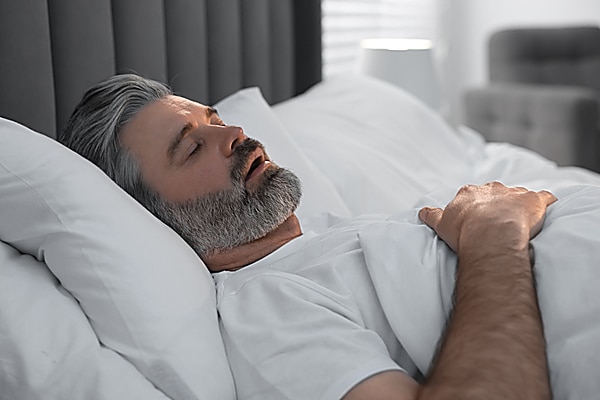
Sleeping on your back, called a supine position, may make sleep apnoea symptoms worse. When lying on your back, gravity can cause the tongue and soft palate to fall backward, which may narrow or block the airway. Many people with sleep apnoea experience more frequent and severe breathing interruptions when sleeping on their backs, and some only have sleep-disturbed breathing when back sleeping.6
If back sleeping is your preferred position, try some modifications. A cervical pillow that supports your neck’s natural curve may help promote better airway alignment. Some people may also benefit from slightly elevating their head and shoulders while sleeping on their backs.
If these methods don’t work, other techniques may help prevent you from rolling onto your back while sleeping. Some people use commercial positional devices or home remedies, such as sewing a tennis ball into the back of a pyjama shirt, to help discourage back sleeping.18
Stomach sleeping analysis
Stomach sleeping, or a prone position, may not be ideal for people with sleep apnoea, as it can strain the neck and may make using a CPAP device more difficult. The twisted neck position required for breathing while face-down can also create its own difficulties.
Gravity naturally helps keep the airway more open when you sleep on your stomach by preventing the tongue from falling backward. And so, some people with mild sleep apnoea may find that sleeping on their stomach helps their symptoms. If you prefer stomach sleeping, using a very thin pillow or no pillow may help reduce neck strain.
Small studies suggest that stomach sleeping may offer certain benefits for people with mild to moderate OSA.7 However, stomach sleeping may be difficult for those using CPAP therapy. Stomach sleeping can present significant challenges with mask fit and comfort, and therefore may not be a practical solution.