






Clinical research in home NIV
Discover key findings from recent clinical research and their implications for treatment decision-making and patient selection.
The MONTANA research programme
Advancing real-world evidence in home NIV
The MONTANA research programme brings together a growing body of real-world evidence designed to improve the understanding and management of patients receiving home non-invasive ventilation (NIV). Using data from the French National Health Data System (SNDS), one of the world’s largest healthcare databases, covering almost 68 million individuals, the programme has analysed more than 66,000 patients receiving home NIV, including 54,545 patients with COPD, 8,842 with obesity hypoventilation syndrome (OHS) and 3,443 with amyotrophic lateral sclerosis (ALS).
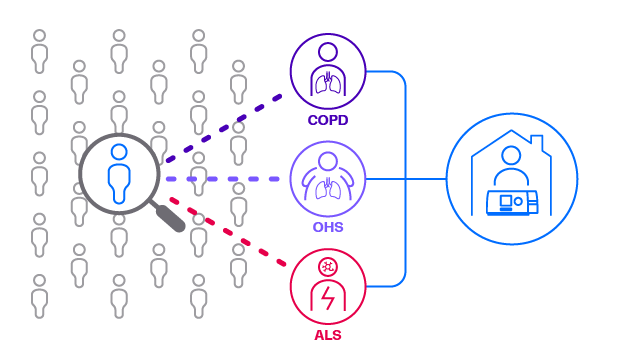
By analysing patient pathways, treatment decisions and long-term outcomes in routine clinical practice, MONTANA provides valuable insights into when patients are identified, how and when home NIV is initiated, and the impact of treatment strategies on survival, hospitalisations and long-term management. Together, these findings complement evidence from clinical trials and help inform clinical decision-making across different respiratory conditions.
The HOT-HMV study
Evidence based benefits of home NIV for COPD
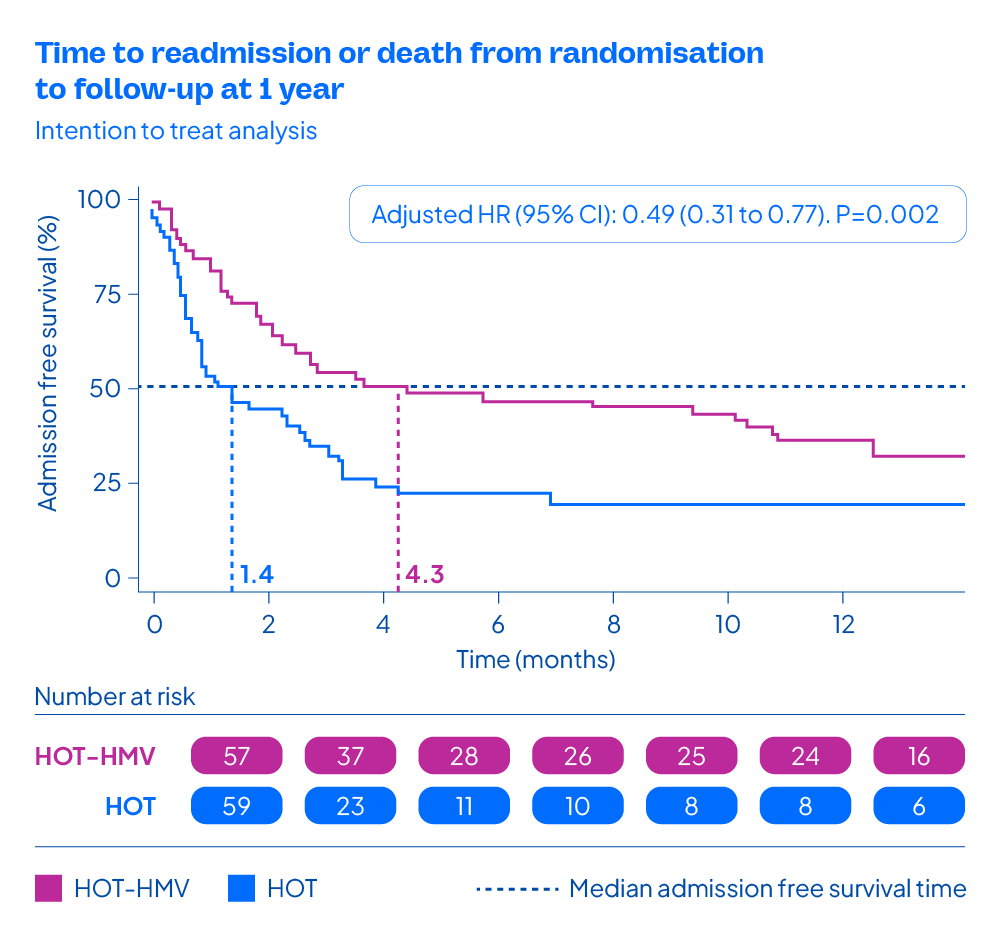
The HOT-HMV study3 has shown a 51% reduction in risk of hospital readmission or death in hypercapnic COPD patients treated with home non-invasive ventilation and oxygen therapy.
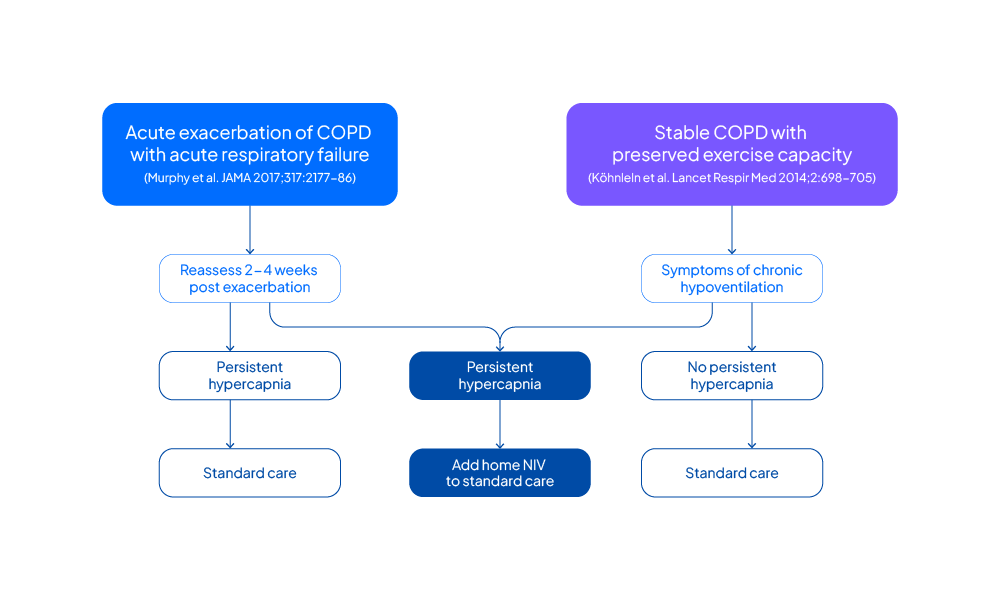
Flow diagram showing patient selection for home NIV based on clinical trial data3,5.
Featured webinars on home NIV
Explore expert perspectives on the latest real-world evidence, clinical research and best practices in home non-invasive ventilation.

What real-world evidence tells us about the future of home NIV for COPD patients
Discover how the MONTANA COPD study is helping to shape the future of home NIV. In this symposium, Prof. Jean-Louis Pépin presents findings from the largest cohort of COPD patients receiving home NIV, followed by an expert discussion on the implications for patient identification, treatment pathways and clinical practice across Europe.

From research to clinical practice: using HFT, NIV and telemonitoring to manage chronic respiratory patients
From research to clinical practice: using HFT, NIV and telemonitoring to manage chronic respiratory patients
Support for investigator initiated research
Resmed believes in the need to support ethical, independent clinical research, conducted by qualified third-party investigators.
This content is intended for health professionals only.
References:
*As shown by 3 and 6 months results on quality of life and compliance
- L Pepin, P. Lemeille, H. Denis, A.Josseran, F. Lavergne, A. Panes, S. Bailly, A. Palot, A. Prigent, Health trajectories before initiation of non-invasive ventilation for chronic obstructive pulmonary disease: a French nationwide database analysis, The Lancet Regional Health – Europe, 2023, 100717, ISSN 2666-7762, https://doi.org/10.1016/j.lanepe.2023.100717.
- Pépin JL,HerquelotE, Denis H, et al. Impact of long-term non-invasive ventilation on severe exacerbations and survival in COPD: a French nationwide cohort study using multistate models. Thorax Published Online First: 19 May 2025. doi: 10.1136/thorax-2024-222392
- Murphy P et al. Effect of HomeNoninvasive Ventilation With Oxygen Therapy vs Oxygen Therapy Alone on Hospital Readmission or Death After an Acute COPD Exacerbation. A Randomized Clinical Trial, JAMA. Published online May 21, 2017. doi:10.1001/jama.2017.4451.
- Murphy PB et al. Cost-Effectiveness of Home Oxygen Therapy-Home Mechanical Ventilation (HOT-HMV) for the Treatment of Chronic Obstructive Pulmonary Disease (COPD) with Chronic Hypercapnic Respiratory Failure Following an Acute Exacerbation of COPD in the United Kingdom (UK). American Journal of Respiratory and Critical Care Medicine 2018;197:A2517
- Köhnlein T, et al., Non-invasive positive pressure ventilation for the treatment of severe stable chronic obstructive pulmonary disease: a prospective, multicentre, randomised, controlled clinical trial. Lancet Respir Med 2014;2:698-705.
- Struik FM, et al. Nocturnal non-invasive ventilation in COPD patients with prolonged hypercapnia after ventilatory support for acute respiratory failure: a randomised, controlled, parallel-group study. Thorax 2014;69:826-34.
- Vogelmeier DF, et al. Global strategy for diagnosis, management, and prevention of COPD. Am J Respir Crit Care Med 2017;195:557-82.
- Ergan B, Oczkowski S, Rochwerg B, et al. European Respiratory Society Guideline on Long-term Home Non-Invasive Ventilation for Management of Chronic Obstructive Pulmonary Disease. Eur Respir J 2019; in press (https://doi.org/10.1183/13993003.01003-2019).
- Nocturnal non-invasive positive pressure ventilation for COPD. Windisch W et al. Expert Rev Respir Med. 2015 Jun; 9(3):295-308
- Dreher M, et al. Noninvasive ventilation in COPD: impact of inspiratory pressure levels on sleep quality. Chest 2011;140:939-45
Content update: 08/2026