How snoring affects your partner’s sleep and your relationship | Resmed UK
What can we help you find?
Search for masks, machines, accessories...

How snoring affects your partner’s sleep and your relationship

Sleep Health Relationships Snoring

When snoring is “just a noise” but feels like so much more

For many couples, snoring is one of those things that’s joked about — teased or brushed off as “just part of sleeping next to someone.” But for the partner lying awake at 2 a.m., it rarely feels funny.

The reality is that snoring can have consequences far beyond mild annoyance. When it happens frequently, it can affect your partner’s sleep quality, daily energy, emotional well-being, and even your relationship. Research shows that habitual snoring, particularly when linked to obstructive sleep apnoea (OSA), negatively impact partners’ sleep and daytime functioning.1

Let’s unpack how and why this happens, how it affects the unseen partner, and what couples can do to improve sleep, health, and harmony.

Snoring is a shared sleep experience

At first glance, snoring might seem like just loud breathing while asleep. But here’s the reality: human sleep is interdependent when sleeping side by side. This means one partner’s sleep behaviour can directly impact the other’s sleep quality.
And it’s common

According to a Sleep Foundation survey of adults whose partners snore, more than half (54%) say their partner snores every night, with many reporting very loud snoring on a regular basis, not just occasional episodes but frequent nightly disruption.2

Why it matters

While some people sleep through any noise, others get awakened or experience micro-awakenings — brief sleep interruptions that reduce the deep, restorative phases of sleep critical for health.

More than just being woken up: the impact on the “invisible patient”

Often, the partner sleeping next to the snorer becomes what sleep specialists sometimes call the “invisible patient.” They don’t have the diagnosis, but they experience the consequences.

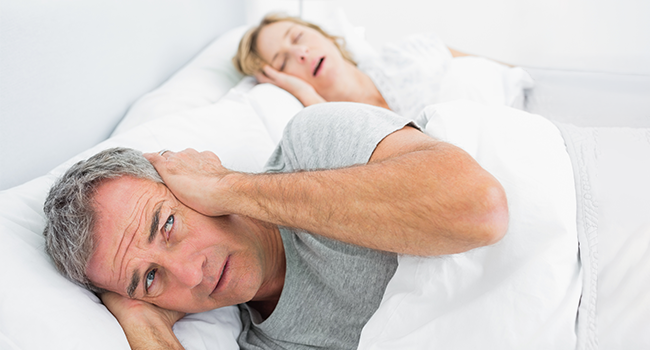
 Couple_woman_snoring

1. Fragmented, poor-quality sleep

Partners of habitual snorers commonly report:

  • trouble falling asleep
  • frequent awakenings
  • unrefreshing sleep
  • overall poorer sleep quality

This isn’t just anecdotal. Sleep studies using objective measures (like polysomnography) partners experience more frequent arousals and spend more time in lighter stages of sleep when snoring is present.3

These repeated interruptions can prevent the brain and body from settling into deeper, restorative sleep. Even if the partner doesn’t fully wake up each time, the night becomes fragmented. Over days and weeks, this can leave them feeling as though they “slept all night” but still wake up tired, a subtle but persistent drain on overall well-being.

 Couple_woman_sleeping_on_table

2. Daytime fatigue and cognitive effects

Poor sleep at night leads to predictable daytime problems in the waking hours. Partners often notice:

  • fatigue and low energy
  • daytime sleepiness
  • trouble concentrating
  • reduced productivity

Sleep fragmentation reduces the mental sharpness that comes from consolidated rest. Tasks that once felt routine, like focusing on meetings, managing household responsibilities, staying patient with children, may start to feel harder than usual.

3. The emotional and mood symptoms

Sleep disruption isn’t just physical; it impacts emotional well-being, too. Studies show that sleep disturbance from snoring correlates with increased risk of stress and depressive tendencies in partners.4  While not everyone develops mood symptoms, chronic broken sleep can increase vulnerability to stress, anxiety, and low mood.

When sleep improves, many couples report not only better rest but also improved mood and relationship satisfaction, highlighting just how closely sleep and emotional health are connected.

4. Long-term health risks

Sleep isn’t a luxury. It’s essential for keeping the body’s systems in balance. When restorative sleep is interrupted night after night, the consequences go beyond feeling sleepy during the day.

Chronic poor or fragmented sleep has been linked to higher blood pressure and greater risk of heart disease and stroke, even in people without diagnosed sleep disorders.5 These effects are thought to stem from how deep sleep supports regulation of blood pressure, stress hormones, and glucose metabolism.

Left unaddressed, snoring and sleep apnoea can become a shared health issue, not just a nighttime nuisance.


How snoring strains relationships and daily life

Sleep is fundamental. When it’s compromised night after night, stress on the relationship grows as well.

Sleep divorce and sleep separation

To cope with chronic snoring and nighttime disruptions, some couples choose to sleep in separate beds or rooms — a trend often referred to as “sleep divorce.”

In one study published in the European Respiratory Journal, female partners of habitual snorers experienced significantly better sleep when they slept alone for just one night, confirming that the snoring itself was directly fragmenting their sleep.6

While some couples find this arrangement improves their individual sleep, it can also reflect deeper stress and unmet needs within the relationship.

Day-to-day friction

Night after night of disrupted sleep can lead to tension in subtle but real ways. Middle-of-the-night nudging, frustrated sighs, or one partner retreating to the couch can turn into arguments the next morning. Over time, this cycle of poor sleep and frustration can fuel resentment, shorten tempers, and create ongoing tension in the relationship. What may have started as light teasing about snoring can gradually become a real source of conflict for both partners.

Unspoken strain and negative emotions

Not all the impact shows up as separate bedrooms or obvious arguments. Sometimes, the strain is quieter. The partner who loses sleep may begin to feel overlooked or unsupported, while the one who snores may feel embarrassed, guilty or frustrated about something they can’t fully control. Over time, these unspoken feelings can create emotional distance, making it harder to feel connected, affectionate and patient with each other.

What to do when your partner’s snoring keeps you awake

If snoring is affecting your sleep and relationship, there are steps you can take — both practical and therapeutic.

1. Start with open, compassionate communication

For the partner who wakes up repeatedly:

  • Choose a calm time to talknot when you’re already tired or frustrated.
  • Share how the sleep disruption affects your energy, mood, and day-to-day life.
  • Focus on “I feel…” statements (e.g., “I feel exhausted in the mornings…”) instead of accusations.

For the snoring partner:

  • Listen without defensiveness.
  • Ask questions like: “When do you notice the snoring most?” or “How does it feel for you when I bring this up?”
  • Acknowledge that snoring isn’t just “noise”. It’s affecting your partner’s rest.

Good communication creates empathy, shared ownership, and a foundation for working together toward solutions.

2. Explore simple lifestyle and bedtime adjustments

Some people see improvement with:

  • changing sleeping positions (e.g., side instead of back)
  • avoiding alcohol or heavy meals before bed
  • using nasal strips or humidifiers

But these are often short-term or partial fixes.

3. Seek a professional evaluation

If snoring is loud, frequent, or accompanied by pauses in breathing, it may be a sign of OSA, a common but treatable sleep disorder.

Professional evaluation, often involving a sleep specialist, can determine:

  • whether there’s an underlying sleep disorder
  • what treatment options are appropriate
  • and how to improve sleep for both partners

4. Treatment makes a difference for both partners

A sleep specialist can determine whether snoring is benign or related to OSA. If treatment is needed, the benefits often extend beyond the person diagnosed.

A systematic review in the Journal of Clinical Sleep Medicine found that when patients begin effective OSA treatment, including CPAP (continuous positive airway pressure) therapy, partners frequently report better sleep quality and fewer daytime symptoms.¹

When couples approach treatment as a team, outcomes tend to improve even further, reinforcing that sleep health is a shared journey.

Realigning sleep, health, and relationship harmony

Snoring doesn’t have to be an unsolved annoyance you just live with. It’s a real phenomenon that can affect physical health, emotional well-being, productivity, and relationship quality.

By understanding the true snoring impact on a partner, communicating openly, and seeking evaluation when appropriate, couples can protect both their health and their connection.

Sleep should restore you — not divide you.

Take the next step toward better sleep

If snoring is affecting you or someone you love, it may be time to explore options that address the root cause. Take our online sleep assessment and discuss the results with your doctor.

Disclaimer:

This blog post contains general information about medical conditions and treatments. It is not intended to be a substitute for professional medical advice, diagnosis or treatment. The information is not advice, and should not be treated as such. You must not rely on the information on this website as an alternative to medical advice from your doctor or other professional healthcare provider.

If you have any specific questions about any medical matter, you should consult your doctor or other professional healthcare provider. If you think you may be suffering from any medical condition, you should seek immediate medical attention. You should never delay seeking medical advice, disregard medical advice, or discontinue medical treatment because of information on this website. The views expressed on this blog and website have no relation to those of any academic, hospital, practice, or other institution with which the authors are affiliated and do not directly reflect the views of Resmed or any of its subsidiaries or affiliates.

References:
  1. Luyster, F. S. (2017). Impact of obstructive sleep apnea and its treatments on partners: A literature review. Journal of Clinical Sleep Medicine, 13(3), 467–477. https://doi.org/10.5664/jcsm.6504
  2. Sleep Foundation. (2024, January). When your partner snores, no one sleeps [Survey]. Sleep Foundation. https://www.sleepfoundation.org/sleep-news/when-your-partner-snores-no-one-sleeps
  3. Beninati, W., Harris, C. D., Herold, D. L., & Shepard, J. W., Jr. (1999). The effect of snoring and obstructive sleep apnea on the sleep quality of bed partners. Mayo Clinic Proceedings, 74(10), 955–958. https://doi.org/10.4065/74.10.955
  4. Chen, M., Wu, S.-Y., Yu, C.-C., & Chu, C.-M. (2023). Sleep disturbance and depressive tendency in bed partners of patients with obstructive sleep apnea. Neurology Asia, 28(2), 367–374. https://doi.org/10.54029/2023xze
  5. American Heart Association. (2025). Sleep health and cardiovascular disease risk: Scientific statement summary. Circulation: Cardiovascular Quality and Outcomes. https://newsroom.heart.org/news/sleep-matters-duration-timing-quality-and-more-may-affect-cardiovascular-disease-risk
  6. Blumen, M., Quera Salva, M. A., d’Ortho, M. P., Leroux, K., Audibert, P., Fermanian, C., Chabolle, F., & Lofaso, F. (2009). Effect of sleeping alone on sleep quality in female bed partners of snorers. European Respiratory Journal, 34(5), 1127–1131. https://doi.org/10.1183/09031936.00012209

Get the latest from Resmed

Stay connected and you will be among the first to hear all the latest news and developments.

Please answer the question above

Please answer the question above

By signing up, you agree to our Terms, Privacy Policy, and to receive marketing updates from Resmed.