



CPAP Humidifier: Benefits, Comfort & How It Works | Resmed UK
What can we help you find?
Search for masks, machines, accessories...

CPAP Humidifier: Benefits, Comfort & How It Works

CPAP & Therapy Humidification Seasonal

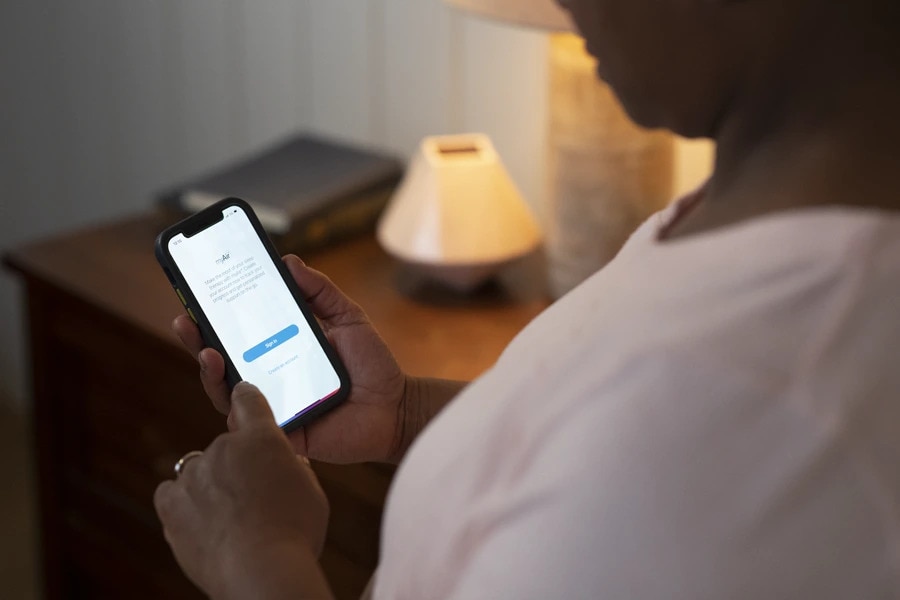
If you’re using CPAP therapy, you already know how important it is for treating obstructive sleep apnoea (OSA). But for many users, one early challenge can make therapy feel less comfortable than expected: dry nose, dry mouth, sore throat, or a “cold air” sensation during the night.

Research shows that up to 56% of CPAP users experience discomfort related to dryness or inhaling cold air.1 And because your nose normally warms and humidifies the air you breathe, the continuous airflow from a CPAP machine — especially at higher pressures — can overwhelm your natural system. This can lead to dryness, congestion, or nighttime awakenings that interrupt your sleep.2

A CPAP humidifier is one of the simplest and most effective ways to reduce these symptoms and improve comfort. By warming and adding gentle moisture to the airflow, humidification can make breathing feel easier and help you stay comfortable through the night.

If you’re looking for a way to ease dryness or make your nightly therapy more comfortable, humidification may be the upgrade you need. This article explains why it helps, who it’s suitable for, how it works, and the accessories, such as heated humidifiers and heated tubing, that can make your therapy feel noticeably better.
Why use humidification?

Humidification adds comfort by delivering warmth and moisture to the air through your CPAP device. This small change can support easier breathing and help reduce some of the most common discomforts CPAP users experience when starting or continuing treatment.

Without enough humidity, many people notice2:

  • Dry nose and dry mouth that feel worse by morning
  • Sore or scratchy throat, nasal congestion, and runny nose
  • Occasional nosebleeds related to mucosal dryness
  • Night‑time awakenings because the airflow feels cool or uncomfortable

Heated humidifiers and heated tubing help maintain a constant temperature from the device all the way to the mask. This can be helpful in winter, very dry environments,  airconditioned rooms, or during colder months when indoor heating systems remove moisture from the air‑.

When the air feels comfortable, you’re more likely to stay asleep and be on therapy through the night, helping you get the full benefit of CPAP without unnecessary interruptions.

Who benefits most from CPAP humidification?

While almost anyone using CPAP can benefit from a humidifier, some groups are especially likely to notice improvement.

• New CPAP users

Starting CPAP therapy introduces your airways to a brand-new experience. Humidification can help smooth out the adjustment period by reducing dryness early on.3

• All-night CPAP users

The longer you use your device each night, the more your airway may dry out, making humidification more valuable.

• People living in dry climates

If you live in an environment with low humidity — such as desert regions, high elevations, or areas with harsh winters — humidification can help counter the dryness in the air.

• People with nasal dryness

A humidifier may help soothe irritation for:

  • Allergy sufferers4
  • Individuals prone to nasal congestion
  • Users waking with a dry or blocked nose
  • Older adults who may be more prone to airway dryness

• Mouth breathers

If you breathe through your mouth at night, you may experience even greater dryness. Humidification, paired with accessories like heated tubing, can help reduce this effect. In addition to humidification, you might consider changing your mask to a full face mask if you don’t have one.

How does a CPAP heated humidifier work?

Humidification works by warming water in a small chamber and adding moisture to the CPAP airflow before it reaches your mask. Modern systems combine the humidifier, heated tubing and built-in climate control technology to keep temperature and humidity steady from the device to your mask, reducing dryness and preventing condensation (“rainout”).

AirSense 11 Humidification

Here’s how the main components work together.

1. The humidifier

Our latest CPAP devices — such as the AirSense™ 11 — include the HumidAir™ 11 heated humidifier, which uses a warm water chamber to deliver a steady, comfortable level of moisture. You can adjust the humidity level in the Options menu from 1 to 8 (with 4 as the default). With Climate Control, the heating plate automatically  adjusts temperature based on ambient humidity, airflow, and the setting you’ve chosen.

Key benefits of a heated humidifier

  • Adds adjustable warmth and humidity for comfort
  • Helps ease dryness, irritation, nasal congestion and runny nose
  • Maintains steady humidity levels with Climate Control, even as room conditions change
  • Supports easier breathing and may reduce nighttime disturbances

Cleaning and care

  • Daily: Empty and wipe the humidifier tub, air dry out of direct sunlight, refill with potable water
  • Weekly: Clean air tubing and humidifier tub in warm water with mild dishwashing liquid, or soak tub in 1:9 vinegar solution
2. Heated tubing: ClimateLineAir™

For many users, adding heated tubing can enhance CPAP comfort from start to finish. When used with a compatible HumidAir™ 11 humidifier, a heated tube like ClimateLineAir™ 11 helps maintain a steady air temperature from the device to your mask. It also enables Auto Climate Control, allowing your device to automatically adjust to changing room conditions.

Why heated tubing matters

  • Keeps air warm and comfortable from the device to the mask
  • Allows the device to adjust humidity and tube temperature in real time
  • Helps limit condensation without you needing to lower your preferred humidity level
  • Built-in temperature sensing at the mask end helps deliver a constant, comfortable temperature where you feel it

Shop ClimateLineAir™ 11 Heated Tubing

3. Climate Control technology

AirSense™ 11 uses Climate Control, a smart system combining HumidAir™ 11 with ClimateLineAir™ 11 to keep humidity and temperature in the right range all night. It adapts to changes in your room so your airflow stays comfortable and constant.

In auto mode:

  • Temperature is managed automatically (default 27°C).
  • Relative humidity is held at approximately 85% regardless of room conditions.
  • System prevents both dryness (too little humidity) and rainout (too much condensation).

In manual mode:

  • You control both humidity level and tube temperature individually.
  • Manual mode allows you to adjust humidity and temperature; however, rainout protection is not guaranteed. If rainout occurs, try increasing the tube temperature.
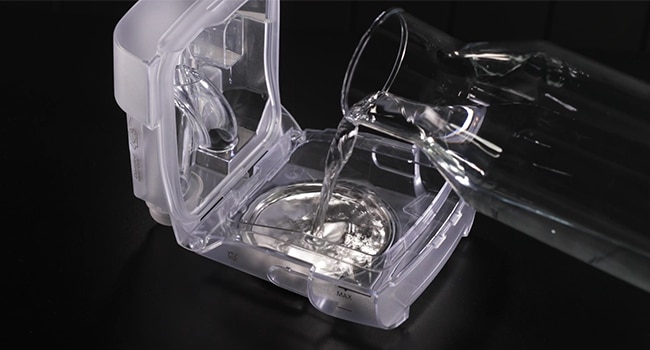
Filling tub with water
4. CPAP machine humidifier water: what to use

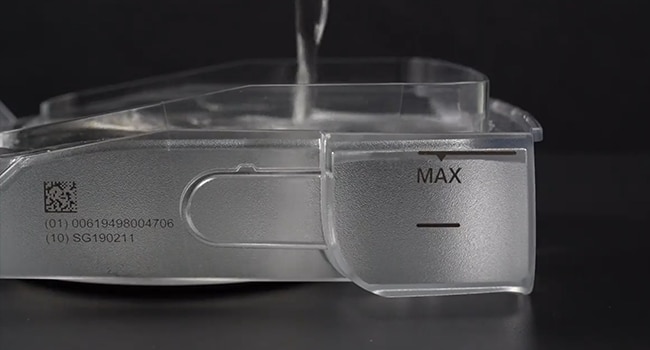
For optimal performance, fill the humidifier tub with drinking quality (potable) water at room temperature, up to the maximum water level mark. This helps support consistent humidity delivery and proper device function.

Compatibility with your device

Different devices have different humidifier and tubing systems. Make sure you select accessories made for your model.

  • AirSense™ 11: Compatible with the HumidAir™ 11 humidifier and ClimateLineAir™ 11 heated tubing.
  • AirSense™ 10: Uses the HumidAir™ humidifier and pairs with ClimateLineAir™ 10 heated tubing.

How does a Heat and Moisture Exchanger (HME) work?

An HME is a passive humidification system that captures heat and moisture from exhaled breath and returns it during inhalation. It uses a moisture-retaining material to warm and humidify incoming air — without water or power.

HumidX™ and HumidX™ Plus (AirMini™)

HumidX™ and HumidX™ Plus are compact HME cartridges designed with corrugated exchange material to optimise heat and moisture transfer. Their placement close to the patient improves efficiency compared to traditional in-line HMEs, supporting better comfort. HumidX™ Plus is intended for drier environments, providing enhanced humidification.AirMini™ uses HumidX™ or HumidX™ Plus waterless humidification cartridges instead of a traditional water chamber, making it a compact, travel-friendly CPAP solution with built-in humidification. Discover more about AirMini™.

AirMini Humidification Instructions

Smart Do’s & Don’ts for getting the most comfort from your CPAP humidifier

 A well setup humidifier can help improve your CPAP experience. These simple tips should keep things running smoothly and comfortably.

DO: Make your humidifier work for you

  • Finetune the humidity to your comfort level: Everyone’s comfort level is different. Feel free to adjust humidity or temperature settings until the airflow feels right. You may need higher humidity in winter and lower settings in humid summer months.
  • Keep your equipment clean and fresh: Your humidifier tub needs regular cleaning to keep it sanitary and effective. Learn how to clean your CPAP humidifier:
    https://www.resmed.co.uk/patient/living-with-sleep-apnoea/cleaning-cpap-equipment/
  • Talk to your care provider: They can guide you on the right CPAP humidifier attachments, climate settings, or mask style, especially helpful if dryness continues despite usage.
  • Give “Auto” Climate Control a try (if your device supports it).
    Auto mode adjusts temperature and humidity automatically through the night, making comfort effortless. Great for beginners or anyone who doesn’t want to tweak settings manually.
  • Always place the device on a level surface, lower than your head, to prevent the mask and air tubing from filling with water.

DON’T: Make these common mistakes

  • Don’t leave stagnant water in the tub: Always empty and dry the tub during the day to prevent bacterial growth.
  • Don’t run humidification without compatible heated tubing:  The humidifier can be used with standard or SlimLine tubing, but without heated tubing, you may experience increased  condensation build-up.
  • Don’t assume discomfort is “just part of CPAP”: If therapy feels drying or irritating, humidification may be the missing piece. Explore tips to make therapy more comfortable: https://www.resmed.co.uk/patient/living-with-sleep-apnoea/getting-used-to-treatment/
  • Don’t overfill the humidifier tub: Overfilling may cause water to enter the device and air tubing.
  • Don’t ignore room conditions: Cold rooms, open windows, or air conditioning can increase rainout. Simply adjusting tube temperature or slightly warming the room often helps.
  • Do not fill the humidifier tub with hot water as this could lead to excessive air temperature at the mask. Ensure the water is cooled to room temperature before filling the humidifier tub.
  • Do not place the device on its side while the humidifier tub is attached as water might get into the device and reduce motor life.

Conclusion: Small upgrade, big comfort

Humidification is a simple adjustment with a big payoff for many CPAP users. Whether you’re experiencing dryness, adjusting to therapy, or living in a dry climate, adding a humidifier and the right accessories can make a meaningful difference in how you feel each night.

Disclaimer

PROMOTIONAL MATERIAL – CE-marked medical devices (CE0123). Manufacturer: Resmed. Local contact: Resmed. Please refer to the instructions for use for relevant information related to any contraindications, warnings and precautions.

 This blog post contains general information about medical conditions and treatments. It is not intended to be a substitute for professional medical advice, diagnosis or treatment. The information is not advice, and should not be treated as such. You must not rely on the information on this website as an alternative to medical advice from your doctor or other professional healthcare provider.

 If you have any specific questions about any medical matter, you should consult your doctor or other professional healthcare provider. If you think you may be suffering from any medical condition, you should seek immediate medical attention. You should never delay seeking medical advice, disregard medical advice, or discontinue medical treatment because of information on this website. The views expressed on this blog and website have no relation to those of any academic, hospital, practice, or other institution with which the authors are affiliated and do not directly reflect the views of ResMed or any of its subsidiaries or affiliates.


References
  1. Rakotonanahary D, Pelletier-Fleury N, Gagnadoux F, Fleury B. Predictive factors for the need for additional humidification during nasal continuous positive airway pressure therapy. Chest. 2001 Feb;119(2):460‑5.
  2. Patil SP, Ayappa IA, Caples SM, Kimoff RJ, Patel SR, Harrod CG. Treatment of adult obstructive sleep apnea with positive airway pressure: an American Academy of Sleep Medicine systematic review, metaanalysis, and GRADE assessment. J Clin Sleep Med. 2019 Feb;15(2):30134.
  3. Mador, Jeffrey M., Matthew M. Krauza, Adnan Pervez, Dawn Pierce, and Mark Braun. 2005. “Effect of Heated Humidification on Compliance and Quality of Life in Patients With Sleep Apnea Using Nasal Continuous Positive Airway Pressure.” Chest 128 (4): 2151–2158.
  4. Winck JC, Delgado JL, Almeida JM, Marques JA. Heated humidification during nasal continuous positive airway pressure for obstructive sleep apnea syndrome: objective evaluation of efficacy with nasal peak inspiratory flow measurements. Am J Rhinol. 2002 May-Jun;16(3):175-7. PMID: 12141777.